


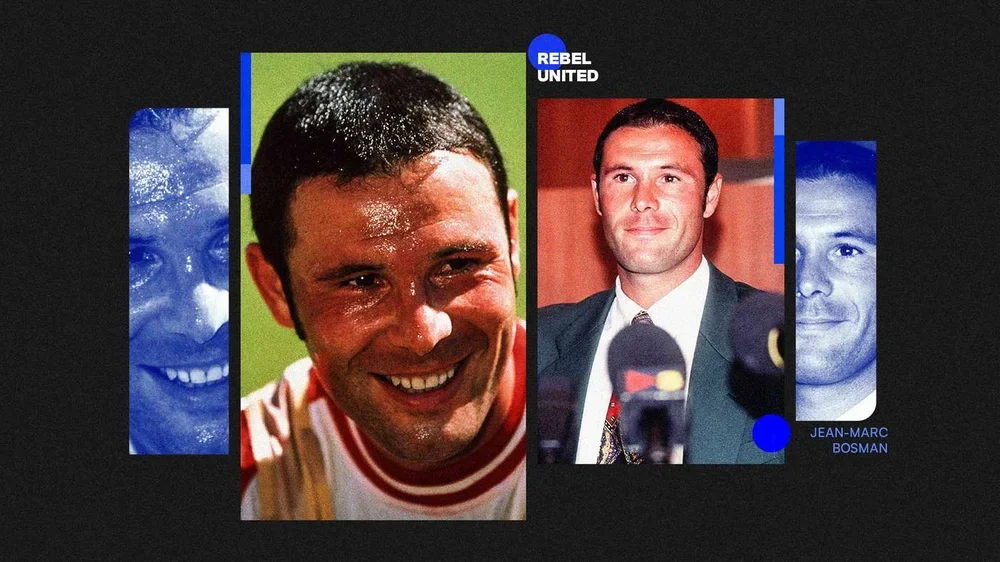
“The poor, wounded Bosman made players richer, but I get nothing out of it.” The landmark Bosman ruling in 1995 revolutionized football, shifting the balance of power toward players and speeding up the sport’s professionalization. Yet, almost no one remembers the man behind the case. This is part 13 of our series “Rebel United.”
The man who made all professional footballers—and their agents—far wealthier than he ever was never intended to change the game forever. Jean-Marc Bosman did not want to be a rebel. He never planned to file a lawsuit against his club RFC Liège, the Belgian Football Association, and eventually UEFA. He did not set out to “give football something great,” as he now describes it, and above all, he never wanted to pay the highest price for it.
“My life was chaotic,” he says, describing what was in fact a complete breakdown: alcohol, debt, depression, a domestic violence lawsuit, and well-known financial hardship. Bosman revolutionized football, but football no longer wanted him. “It’s sad, but from the start, they tried to erase me. I was ignored. But I realized you pay a price when you take on an established authority,” he says today.
Bosman wanted justice at the time, yes, but for himself. He simply wanted to keep playing football and move to French second-division club USL Dunkerque after his contract with Belgian top-flight side RFC Liège expired in the summer of 1990. At 25, Bosman was a moderately talented attacking midfielder. He trained at Standard Liège and made his professional debut there, but had only played 25 top-flight matches in the previous two years with local rivals RFC Liège.
Bosman was happy his contract with RFC Liège was ending. The final months had been tough after a falling out with the coach and management. The club offered him a contract extension, but at a monthly wage of only about 850 euros—just a quarter of his original salary. That was absurd even then; a factory worker in Belgium was earning around 1,000 euros at the time.
The offer from Dunkerque came at the right time. True, it was in the second division, but in France, a bigger football nation than Belgium, and in a city right on the border with his homeland. It was a strong offer for a player like Bosman.
The problem was that RFC Liège refused to let Bosman go easily, demanding between 600,000 and 800,000 euros as a transfer fee for their number 10. Note that this was for a player whose contract had expired and who had just been offered a new deal at the minimum wage in Belgium. Dunkerque either could not or would not pay this fee, Liège blocked the move, and Bosman became a rebel.
He gave up his professional status and returned to amateur status, which allowed him to leave Liège. To stay fit, he initially joined a French fifth-division club, then a year later a top-flight club on the island of Réunion, a French overseas department in the Indian Ocean. More importantly, Bosman filed a lawsuit against his former club and the Belgian Football Association seeking compensation.
Sportingly, Bosman’s move was unremarkable. He was unhappy on Réunion, and when he returned to Belgium in 1992, no club wanted to sign him. He applied for unemployment benefits, but was rejected. During those years, the former professional player lived in his parents’ garage.
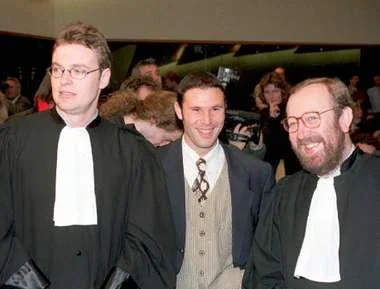
The Bosman ruling divided football into before and after. In court, Bosman had better luck. In 1990, Belgian courts ruled that his move to Dunkerque should not have required any transfer fee. But the club and the Belgian Football Association appealed; UEFA argued that ordinary courts had no jurisdiction over football matters. Belgian judges and Bosman took the case to the European Court of Justice, seeking a preliminary ruling that professional footballers should also benefit from the freedom of movement for workers within the European Union.
Football clubs and associations were furious, predicting the end of football. Then-UEFA president Lennart Johansson cried out: “The European Union is trying to destroy club football,” while Sepp Blatter, later FIFA president and then UEFA’s secretary-general, tried to block the decision.
