
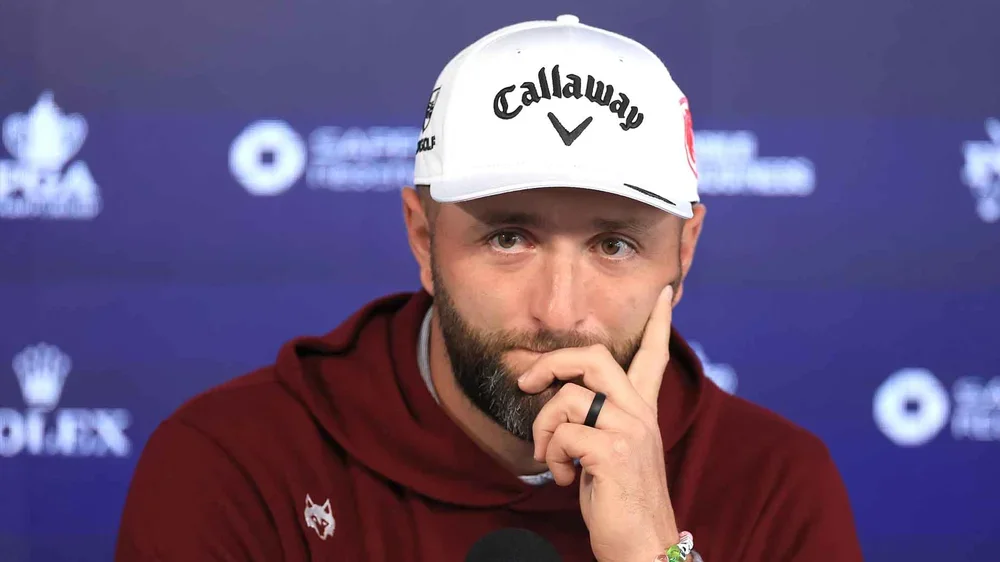
Jon Rahm doesn’t regret leaving the PGA Tour for LIV Golf. But that monumental choice taught him something—lessons that, once revealed, might help chart the course ahead for professional golf.
NEWTOWN SQUARE, Pa. — In April 2024, Jon Rahm sat at Augusta National, months removed from a decision that seemed to be a defining moment in the fractured era of pro golf. He explained how he went from one of the PGA Tour’s most loyal soldiers to LIV Golf’s biggest prize. The move breathed new life into the breakaway league at a time when, after the framework agreement, many thought it was fading. The two sides had been locked in stalemate for over a year, with no major defections, and the stunning June 6 announcement seemed to signal that unification was on the horizon. Then Rahm, the reigning Masters champion, slipped on a LIV letterman jacket and revived golf’s civil conflict.
Months later, arriving at Augusta as the defending champion, Rahm expressed hope that his seismic move would be the last piece in the great golf chess game—ending the sport’s fracture. “I understood my position, yes. And I understood that it could be, what I hoped, a step towards some kind of agreement,” he said that day at the 2024 Masters. “Or more of an agreement or expedited agreement.”
Rahm, like all elite golfers, loves control, even though golf often hinges on chance, luck, or fate. He wants to dictate everything: schedule, ball flight, recovery, fitness, travel, and especially narratives. That control is difficult to shape, and Rahm now finds himself, two-and-a-half years after his LIV U-turn, with the league facing an uncertain future. The Saudi Arabian Public Investment Fund announced it would withdraw financial backing after the 2026 season. Rahm’s move never brought professional golf together—a goal he now says was never part of his motivation for switching sides.
“I was never thinking that I was going to be any sort of weight that would tip the scales to make things come together,” Rahm said Tuesday at Aronimink Golf Club ahead of the 2026 PGA Championship. “That was never an argument in my mind. When asked if that was the case for people to come together, that would be great. I never made a decision based on that.”
Since his LIV switch, Rahm has become the ultimate dichotomy—an inner conflict that could define this era of pro golf. He once pledged “fealty” to the PGA Tour and said $400 million wouldn’t change his life. Then he left for LIV and admitted money played a role in deciding to “create” a new legacy. He is a two-time major winner who believes he is “unfairly” judged for his major record. He lives for the Ryder Cup but risked sacrificing that by joining LIV. He is a historian of the game, with an appreciation for tradition equal to his world-beating talent, yet he left all that behind to play 54-hole (now 72-hole) shotgun starts. He is thoughtful and introspective in a world that is often shallow and full of privilege—which made his LIV move a shock.
On Tuesday, with LIV Golf trying to extend its life beyond this season, Rahm confronted his initial choice—one that seemed antithetical to who he had shown himself to be. “We all go back. We all think what could have been and what couldn’t have been. It’s inevitable,” Rahm said. “Whatever decision you’ve made or choice is thought through and made for the reasons that you think are proper reasons, there’s no sense in dwelling on it. In fact, you shouldn’t really be unhappy about it. At least there’s nothing that you regret. If the terms change afterward, like it’s happened with LIV, that things changed a little bit, it’s an afterthought, not a problem from the choice.”
That choice has seen Rahm arrive at majors surrounded by uncertainty. He wasn’t a factor in any of the 2024 majors. After a non-competitive, backdoor top-10 at the 2025